
Reframing Corruption as Making Money Without Adding Value
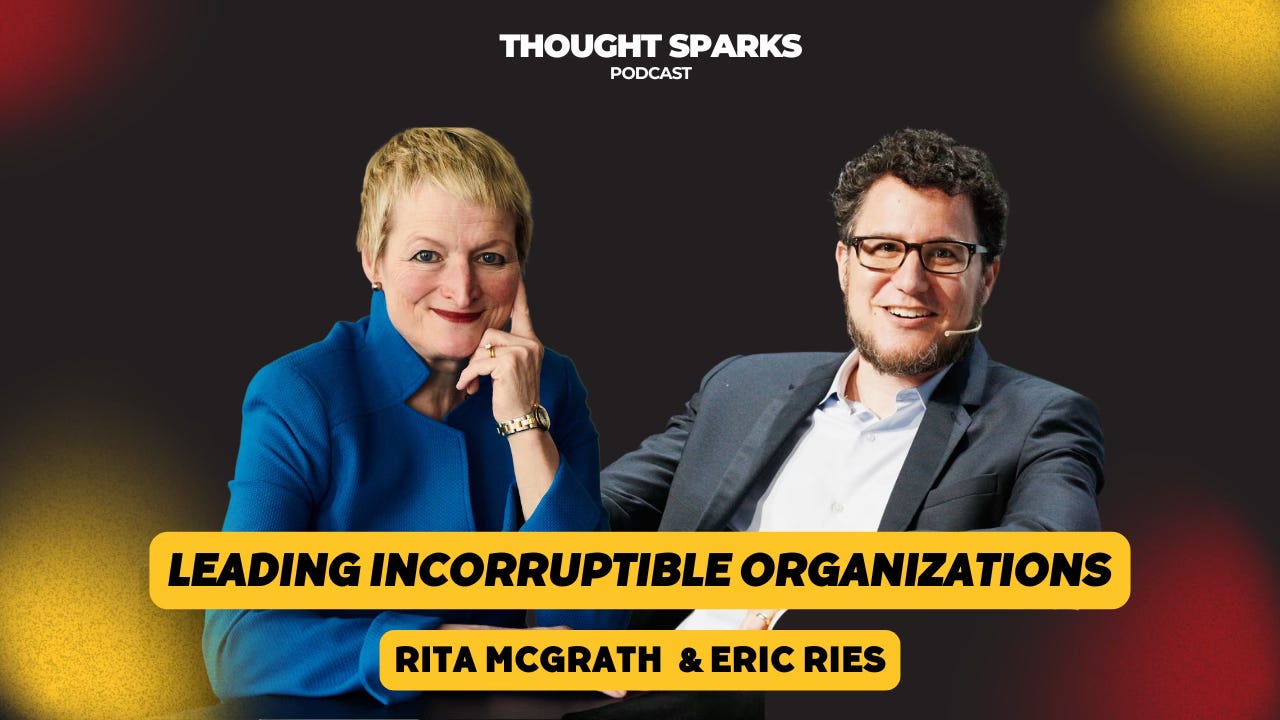
A sneak peek for subscribers at my upcoming conversation with Eric Ries

Most of you know Eric Ries from The Lean Startup and his other books, and maybe from his efforts to create the Long Term Stock Exchange. He helped launch a movement, and changed how a generation of founders and corporate innovators think about building things. Eric has a new book called Incorruptible, which reflects his more recent passions around building good companies that matter, and protecting them from capitalism’s worst predatory tendencies.
Corruption reflects a predatory, extractive mindset
The central idea is this: corruption isn’t just embezzlement or outright fraud. Eric argues we’ve allowed the word to become far too narrow. Our grandparents would have recognized corruption as any transaction that violated the purpose of the thing in question, whether it was illegal or not. And by that broader definition, he proposes that anyone who finds a way to make money without creating value is engaged in corruption.
Even worse, when people benefit themselves financially by destroying value created by founders, employees and community members this is corrupt predation (See also, Bill Lazonick’s huge body of work on this topic).
Once you accept that definition, you start seeing it everywhere. PE firms that benefit themselves by hollowing out the companies they are supposed to revitalize (Toys R Us, bankrupt; Red Lobster, on life support; Radio Shack, gone; Hudson’s Bay Company, dismembered after 300+ years; Kmart, gone; Party City, Sears, and the list goes on…).
Eric describes what he calls financial gravity as an invisible force that acts on organizations the way gravity acts on physical objects. It doesn’t care whether you believe in it. It just pulls. And as our economy has become more and more financialized, that gravitational pull toward extraction and value destruction has become stronger and stronger. The mechanism, as he puts it, is a law of nature. But which values ittransmits? Those are a policy choice, and we can change policy choices if we wish to.
Sol Price, FedMart and the Cost of Financial Gravity
To illustrate how this works, Eric opens with a story I absolutely loved: the largely forgotten legend of Sol Price, who is widely considered the father of modern retail. Sol built FedMart in San Diego in the 1950s with a simple but radical conviction, that he was a fiduciary to the customer, not to shareholders. That implied low prices and high wages. When his competitors ran loss-leader promotions, Sol would literally post their Sunday circular ads in his own stores and tell customers to go buy it cheaper down the street. Because he saw that as his job.
This made FedMart very popular and wildly successful. Success and value, as Eric and I discussed, attracts predators. Once the company went public, the gravity started pulling. Despite his best efforts, an investor group wrested control from him and Sol was eventually locked out of his own office. They literally changed the locks to the office one evening. Then the German Chain that purchased the companyproceeded to drive FedMart into liquidation in seven years, all in the name of profit.
But Sol didn’t retire. He took two weeks off, leased the office upstairs from his former office at FedMart, and started over. He built the Price Club. One of his protégés from FedMart was Jim Sinegal, a former stock boy who’d risen to become an executive. Sinegal quit in protest when Sol was fired, then joined him at Price Club, and eventually started his own company with Sol’s blessing. A few years later, the two companies merged to form Price Costco. A few years after that, they dropped “Price” from the name and the company became simply, Costco.
Yes, that Costco.
Today it’s a $400 billion public company that still caps its margins at 14%, still pays high wages, and still operates by Sol Price’s original fiduciary ethos. Jim Sinegal, that stock boy turned founder, once said he hadn’t learned a lot from Sol Price. He’d learned everything from Sol Price.
A “governance fortress”
So why has Costco endured when FedMart was destroyed? Costco’s valuation certainly makes it an attractive target and one could easily see how looting the assets and goodwill it’s built up could turn someone a tidy profit in the near term.
The reason, in Eric’s words, that it endures is because it was built with a governance fortress. Unfortunately, if you create a super valuable asst, people are going to try to steal it from you and without robust governance they may have an opening.
So the first foundational element is basic compliance. Making sure we follow the rules, making sure no laws are broken, making sure there’s no self-dealing.
Purpose is the second dimension and maybe the most important. It used to be that you couldn’t set up a company without specifying what purpose it served the public – if you organized a railroad, that’s what it was for, to run trains from New York to Chicago, say. Today, company charters are set up to allow the firm to do anything legally permissible and that creates a huge opening for predators to argue that any profits thus created belong to the shareholders. By the way, incorporating as a “B” corp for a specific purpose simply restores the way incorporation used to work.
The third dimension is coherence. To what degree is everything internally aligned around that purpose? Betraying the mission unfortunately happens all the time. When a private equity firm takes over your favorite restaurant, you can taste it in the food. The ownership structure of a company has a certain taste to it. That’s how pervasive this problem is.
The last dimension is what I call integrity. Integrity means both as it would with a person, the ability to make and keep a promise, but also structural integrity. To what degree can an organization be bullied or pushed off course by outside forces?
That blueprint — and what it actually looks like in practice, from public benefit corporations to foundation-controlled companies like Novo Nordisk and IKEA — is the heart of what we get into in this episode. We also talk about the Vectura case (this one will make your jaw drop), the mechanics of how financial gravity transmits values unconsciously through organizations, and why Eric believes the era of shareholder primacy is already over — not aspirationally, but factually.
This conversation is well aligned with my personal goals of figuring out how we can come together to bring capital and production into harmony, perhaps with a Golden Age in mind. I was thrilled Eric was able to join me. The episode drops on the book’s official launch day, May 26, and I’ll be with Eric at his launch party in New York. Watch out for news!
Warmly,
Rita